
Maritime logistics, the engine behind nearly $7 trillion in annual global trade, is undergoing a fundamental transformation. The Fourth Industrial Revolution, defined by automation, artificial intelligence, Internet of Things (IoT), and real-time connectivity… is reshaping transportation and logistics at the system level.
Port Technology International’s Smart Port Terminals paper outlines how this evolution isn’t merely technological, it’s operational, regulatory, and existential. Ports are becoming intelligent ecosystems, and logistics companies must respond with infrastructure, skills, and tools built for a digital-first world.
This article breaks down how smart ports, emissions mandates, and intermodal integration are driving the logistics digital transformation that will define the coming decade.
A new era of digitalisation!
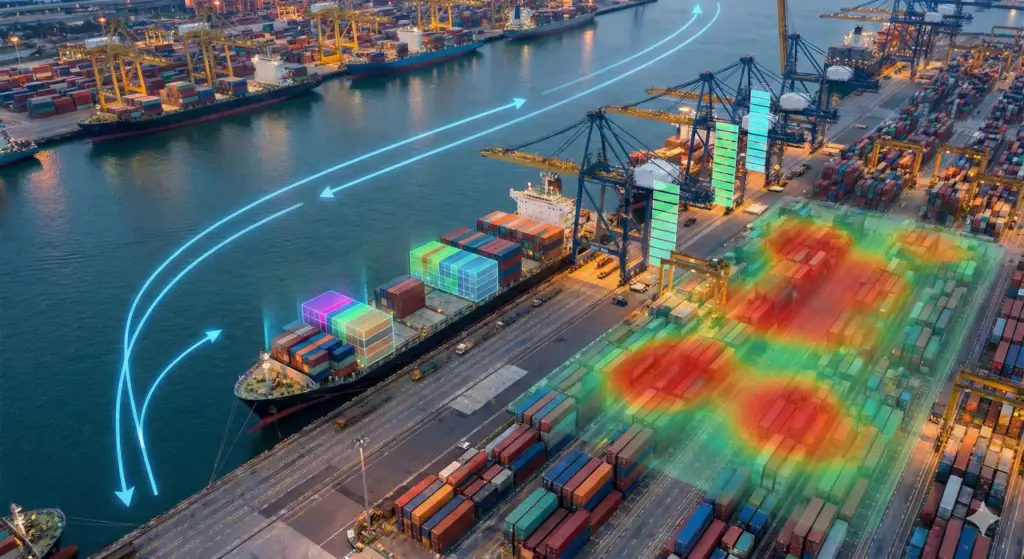
Rotterdam, Hamburg, Busan, these ports are no longer just physical gateways; they are digital ecosystems powered by AI, IoT, and real-time data. With digital twins simulating entire port environments and sensors tracking every crane and container, ports are adopting automation not as a future goal but as current practice.
The implications for logistics operations are profound. Paper-based workflows and siloed communication systems are actively being displaced by predictive maintenance tools, automated berth planning, and real-time tracking platforms. The logistics industry is transitioning from fragmented process chains to integrated, data-driven operations.
For forwarders, shippers, and consignees… this is not a surface-level upgrade, it’s a complete rewiring of supply chain management philosophy. Real-time data is now a requirement, not a bonus. Those still operating on legacy systems are not just behind; they’re invisible to the very networks driving global trade.
Why smart ports matter for freight visibility
Smart ports represent a turning point in maritime logistics digital transformation. These next-gen terminals operate on interoperable data systems that optimize everything from ETAs to yard operations. The more intelligent the port, the more precise the logistics planning that surrounds it.
Accurate vessel arrival times enable better container flow management, minimizing port congestion and demurrage risk. Integrated berth scheduling reduces idle time and supports faster turnaround. Predictive analytics applied to congestion, customs queues, and weather conditions enable upstream decisions before downstream delays escalate.
For logistics companies and professionals, the benefits are tangible: tighter cost control, improved on-time performance, and reduced manual intervention. In a supply chain increasingly judged on transparency and reliability, visibility is no longer a differentiator, it’s infrastructure.
Sustainability and compliance are forcing digital acceleration
With maritime emissions accounting for 2.9% of global CO₂ output, environmental scrutiny is intensifying. The EU Emissions Trading System (ETS), Corporate Sustainability Reporting Directive (CSRD), and IMO decarbonization targets are making emissions visibility as essential as cargo tracking.
But emissions tracking remains one of the logistics industry’s most underdeveloped capabilities. That’s where Dockflow’s RealCalc® engine comes in. It leverages satellite AIS, GPS positioning, and verified routing data to calculate emissions per container, per route, in real time.
Crucially, it supports both tank-to-wake and well-to-wake reporting, a non-negotiable for CSRD compliance.
Smart ports feed this ecosystem. The structured, reliable data they produce forms the backbone of defensible Scope 3 emissions reporting. Without their input, emissions calculations remain assumptions. With them, they become auditable truth.
Redefining resilience in a volatile shipping market
Global shipping has become a pressure cooker of geopolitical, environmental, and operational risk. Red Sea blockages, Panama Canal droughts, and climate-induced port closures have transformed volatility from an exception to a structural feature of maritime logistics.
In this landscape, resilience cannot be built on gut instinct or historical averages. It requires real-time situational awareness and predictive logistics capabilities. Smart logistics platforms can pull AIS data, live port metrics, vessel reliability scores, and terminal congestion levels to offer re-routing options with minutes (not days) of lead time.
Resilience, then, is not just a strategic posture. It is a calculable outcome driven by data velocity and visibility depth. The companies thriving in this era are not the largest or cheapest, but the fastest to interpret and act on real-world signals.
Intermodal integration is the next frontier
Modern ports are expanding beyond their quayside boundaries to become logistics orchestration centres. Railheads, barge terminals, and last-mile trucking operations are being woven into a single, digitized fabric.
For supply chain leaders, this is not merely about asset coordination. It’s about full-journey orchestration. Digital platforms that unify vessel, rail, and road data create a single source of truth from factory gate to final destination.
Dockflow is already preparing for this future by integrating truck and train tracking into its visibility platform. This approach aligns with where the logistics industry is headed: seamless, secure, and compliant door-to-door traceability across all transport modes.
Bridging the maritime digital skills gap

Even the most sophisticated digital tools fail in the hands of undertrained operators. A central challenge in maritime logistics digital transformation is not just technological, it’s human. The shift to predictive analytics, sustainability frameworks, and real-time collaboration requires new competencies across operations, compliance, and IT.
EU-funded programs and industry-led academies are beginning to bridge this gap, offering courses in emissions reporting, data systems management, and AI-driven logistics. But speed matters. The competitive landscape will not wait for late adopters to catch up.
True transformation demands that logistics companies invest in talent with the same urgency as they do in infrastructure. Because digital maturity is not just about tools, it’s about teams!
Investing in the right systems pays off
Governments are pouring capital into next-gen port infrastructure: fiber connectivity, port community systems, customs digitization, and AI-enhanced berth planning. The private sector must follow suit.
Logistics companies don’t need to reinvent the wheel. Platforms like Dockflow provide immediate interoperability with modern port systems, allowing forwarders to benefit from data infrastructure without developing it internally and dealing with continuous updates and bugs.
This isn’t just operational convenience, it’s ROI on multiple fronts. The right digital transformation strategy improves compliance, accelerates decision-making, and enhances customer satisfaction. Long-term, it is the difference between competing and catching up.
Conclusion: Digital ports, visible supply chains, resilient logistics
The Fourth Industrial Revolution has forcibly redrawn the map of global trade. Ports are no longer warehouses by the water, they are data engines at the heart of the supply chain.
Supply chain visibility, emissions compliance, and real-time tracking are no longer aspirational. They are operational prerequisites. Logistics companies that embrace this new normal will not just survive, they will lead.
The future of maritime logistics is not analogue, delayed, or reactive. It is connected, compliant, and predictive.
And for those who can see clearly, the future is already here.