
Stream the Podcast on your favorite Platforms:
The largest U.S. trade tax increase in thirty years was struck down overnight. Within hours, a new tariff replaced it. For European freight forwarders, the legal ground shifted, but the operational pressure didn’t.
Last week, the U.S. Supreme Court did something unprecedented in modern American trade history: it struck down a sitting president’s tariff programme. The 6-3 ruling declared that the IEEPA-based tariffs imposed on Liberation Day in April 2025 exceeded presidential authorit, ending a regime that had collected approximately $160 billion from importers over nearly twelve months.
And then, within hours, a replacement tariff arrived.
In the latest episode of our podcast, The Dockflow Dispatch, Dockflow co-founder Pauline Van Ostaeyen, and Michiel Gabriëls, unpacked what the ruling means in practice for freight forwarders working European import and transatlantic lanes. This post distils the five key takeaways every logistics professional should act on this week, not next quarter.
The chaos eased.
The problem didn’t.
Effective U.S. tariff rate — where we’ve been, and where we are.
baseline
(IEEPA)
(Section 122)
The Legal Landscape Has Changed, But Tariffs Haven’t Disappeared
The Supreme Court’s ruling was decisive. Chief Justice Roberts wrote that the administration had relied on just two words in a 1977 emergency powers law — “regulate” and “importation” — to justify sweeping tariff authority. As Michiel Gabriëls explained on the episode: “Roberts concluded that those words ‘cannot bear such weight.’ And the split matters, Gorsuch and Barrett, both Trump appointees, joined the majority. This wasn’t a close political call. It was a genuine legal conclusion that the administration had fundamentally overreached.”
But here is the critical point for anyone managing freight budgets: the IEEPA tariffs were immediately replaced by a 15% global tariff under Section 122 of the Trade Act. The effective tariff rate has dropped from a peak of roughly 27% to around 9–10% today. That sounds like relief, until you recall that the pre-2025 effective average was approximately 2.4%.
As Pauline put it bluntly: “We’re still nearly four times higher than we were before any of this started. The chaos has eased. The structural increase has not.”
The Section 122 tariff comes with a hard 150-day expiration, approximately 24 July 2026, and a statutory 15% ceiling. Extending it beyond that window requires Congressional approval, which is far from guaranteed in the current political environment.
Port Fees on Chinese-Built Vessels Are a Separate — and Escalating — Problem
One detail that the Supreme Court ruling did not touch: the Section 301 vessel port fees targeting Chinese-built ships. These fees have been live since October 2025 and operate under entirely separate legal authority.
The numbers are significant and growing. According to Drewry’s modelling, a Chinese-built vessel operated by a non-Chinese carrier, think MSC, Maersk, or Hapag-Lloyd, currently faces around $180 extra per FEU on Asia–U.S. West Coast routes. That escalates to $338 per FEU by 2028. For Chinese carriers like COSCO operating their own vessels, projections reach $1,400 per FEU by April 2028; a figure that could exceed half the spot freight rate.
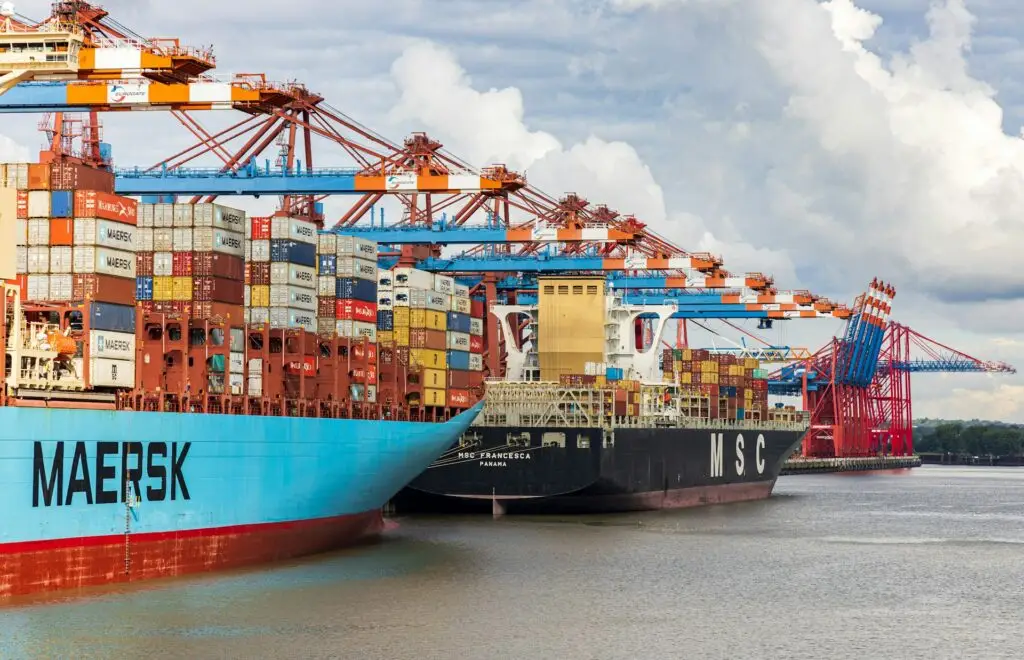
The fleet exposure across the industry is enormous. Michiel shared the specifics: “MSC has 92% of its orderbook from Chinese shipyards. Hapag-Lloyd 89%. Maersk 79%. These companies are actively rotating Chinese-built ships off U.S. trades right now.”
Those ships don’t disappear. They redeploy — predominantly onto Asia-Europe and intra-Asian routes. For European forwarders, that means additional capacity on the lanes they depend on for Asian import freight, which translates directly into rate pressure and tighter margins on business that was supposed to compensate for declining transatlantic volumes.
European Port Data Tells a Story of Structural Shift, Not Temporary Disruption
The podcast walked through 2025 throughput data from Hamburg, Antwerp-Bruges, and Rotterdam, and the pattern is consistent.
Hamburg’s headline throughput was up 7.3% for the full year. But U.S.-bound container traffic collapsed 25.6%. The port compensated almost entirely through surging Asian volumes: China up 6.5%, Malaysia up 84%, India up 49%. As Michiel noted: “If your model is built around transatlantic westbound freight, those volumes aren’t coming back to 2024 levels under any plausible near-term scenario.”
Antwerp-Bruges achieved a historic milestone, surpassing Rotterdam in Q1 2025 container volume for the first time, before Q3 throughput fell 2.4% year-on-year. Steel exports to the U.S. dropped more than a third under Section 232 tariffs. Rotterdam faced compounding pressures from alliance reshuffling, Red Sea diversions, and a terminal strike.
The broader industry context is equally sobering. Kuehne+Nagel’s Q3 2025 EBIT was down 34%, prompting a CHF 200 million cost reduction programme and over 1,000 job cuts. DHL was downgraded. DSV trimmed its outlook.
But buried in Kuehne+Nagel’s results was a signal Pauline flagged as essential: “Demand for customs clearance and consulting services remained high due to the tariff situation and increasing complexity. In the middle of a 34% EBIT collapse, one service line held up, because the same complexity that crushed volumes created demand for people who could help navigate it.”
Three Moves Freight Forwarders Should Make This Week
The episode closed with three concrete, actionable recommendations. Not strategic platitudes, moves you can execute now.
Update Every Contract with Tariff Adjustment Clauses
The 150-day Section 122 clock is ticking. Any contract or quote on U.S.-bound freight without tariff contingency language is carrying unpriced risk. CLECAT has already issued guidance to European freight association members on updating contract language, and the podcast strongly recommended reviewing it immediately.
The administration has already signalled new Section 301 investigations and potential Section 232 expansions into copper, lumber, and semiconductors. As Michiel warned: “The regime after Section 122 is likely to be more targeted and more complex, not simpler.”
Build Customs Complexity Into Your Service Offering
The regulatory landscape around U.S.-bound freight now includes Section 122 as the baseline, Section 301 product-specific rates, Section 232 for steel and aluminium, anti-transshipment rules imposing 40% tariffs on goods exceeding 30% content from higher-tariffed countries, and vessel port fees applied at the U.S. port regardless of cargo type.
Pauline framed the opportunity clearly: “The forwarder who calls a client next week and says ‘here’s what the Section 122 expiry means for your specific product category, and here are three scenarios for how to structure your sourcing’ — that forwarder isn’t just solving a problem. They’re building a relationship that doesn’t go away when the regime changes again.”
Whether that means hiring a specialist, partnering with a customs broker, or credentialing someone already on your team, the window to position this capability is now, not after July.
Diversify Your Lane Portfolio Toward Growing Corridors
Hamburg’s 25.6% drop in U.S.-bound traffic isn’t a dip waiting to reverse. Chinese exporters are diversifying away from America after last year’s tariff shock, redirecting cargo to Europe, Africa, and Latin America. Southeast Asian origins — Vietnam, Indonesia, Thailand, India — are showing significant volume increases on European import lanes.
The freight is moving. The question is whether your business is positioned on the lanes where it’s actually going. Building relationships with Southeast Asian freight agents now, before the urgency peaks, creates a meaningful competitive advantage.
As Michiel observed: “The operational complexity of managing a more diverse lane portfolio, more origin points, more regulatory environments, more handover moments, means the forwarders who have genuine visibility across all of those shipments are going to have a real advantage over those still managing by email.”
The Bottom Line: Uncertainty Is the Product Now
Drewry’s Simon Heaney said the outlook for container shipping is more uncertain now than at the onset of COVID. That comparison isn’t hyperbole. COVID had a trajectory, you could model recovery curves. The current tariff environment operates on court rulings, congressional calendars, and competing political incentives. There is no trajectory to model.
The forwarders who emerge from this period stronger won’t be the ones who waited for clarity. They’ll be the ones who made uncertainty the thing they offered to solve.